
The $2 Million Blind Spot: Why Cruise Lines Can't See the Revenue Sitting On Every Sailing
INDUSTRY INSIGHT • 2026
From dining yield to retail flow: why the absence of real-time passenger intelligence creates invisible revenue gaps that no amount of cabin pricing strategy can close.
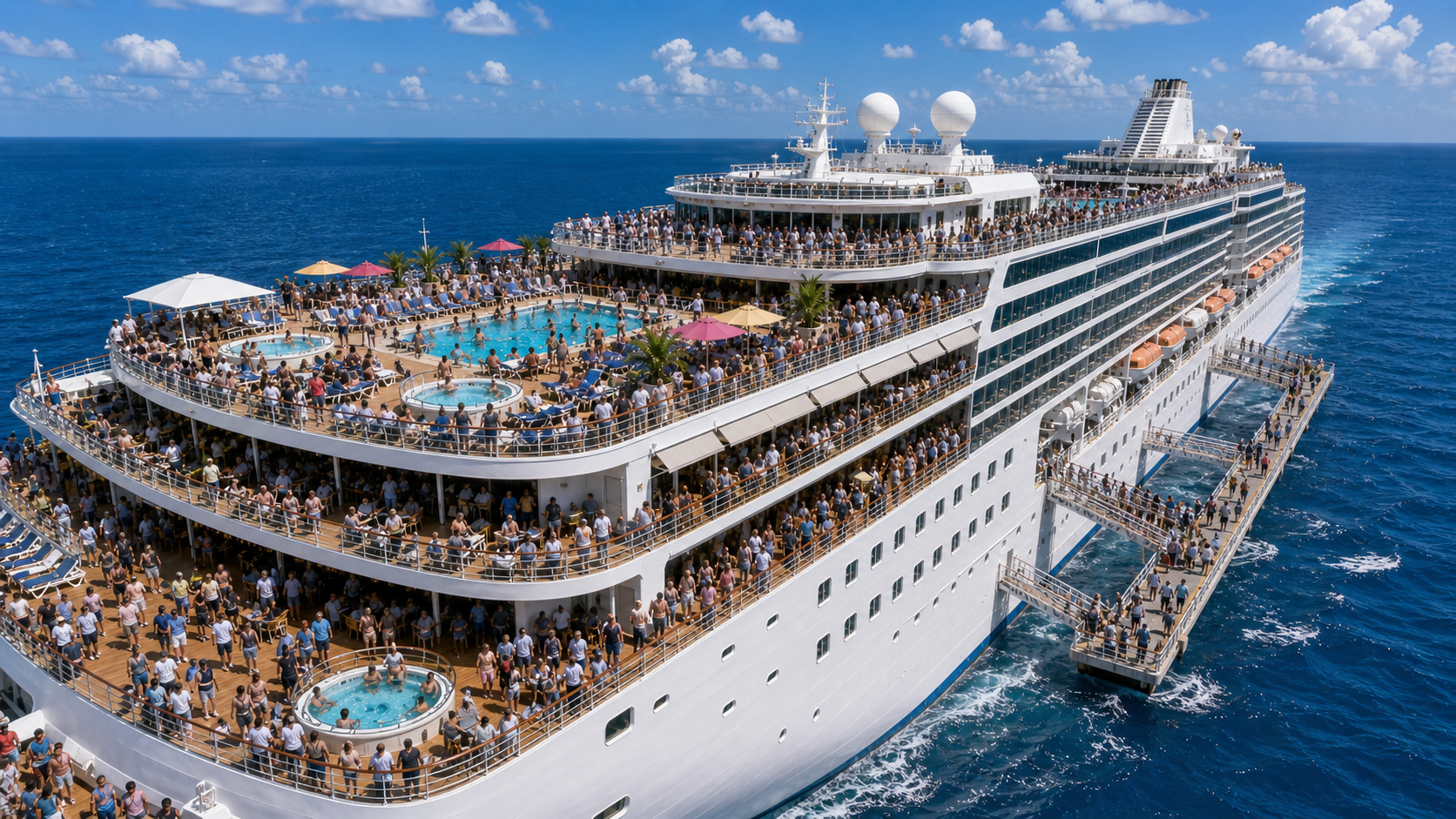
The dining room has a 45-minute wait. Two decks up, the specialty restaurant has tables available. Nobody told the passengers.
The pool bar ran out of staff at 6:45pm because the afternoon traffic model showed it was manageable. The retail corridor peaked at 8pm, an hour after staffing was wound down for the evening.
These are not failure stories. They happen on well-run ships with experienced operations teams.
They happen because cruise lines are managing 5,000 passengers across 15 or more venues on a moving vessel, in real time, with almost no real-time data.
What Guests Actually Complain About
Safari AI recently analyzed over 60,000 publicly available guest reviews across dozens of ships, spanning Carnival, Royal Caribbean, Norwegian Cruise Line, Princess Cruises, and MSC Cruises. Using sentiment classification across five experience segments, the findings challenge some common assumptions about where the guest experience breaks down.
Service and staff consistently outperform. Complaint rates landed in the low-to-mid 30s percent across every vessel tier. Cruise operations teams are, by and large, delivering on the fundamentals.
What they are not delivering on is the structural experience around service: the flow, the access, the sense that things are organized. Embarkation and logistics registered complaint rates above 50% in every tier.
Dining complaints hovered near average everywhere, not because the food quality is mediocre, but because the friction around accessing dining inflates negative sentiment.
Guests are not simply deciding cruises cost too much. They are encountering wait times, crowded venues, and staffing gaps that make the price they paid feel unjustified. That is a solvable operations problem, not a pricing problem.
What We Heard Directly From Operators
Over the past week, Safari AI had discovery conversations with operations leaders at several of the world's largest cruise lines. Five pain points came up consistently. Every one maps directly to the absence of real-time flow intelligence onboard.
Operators have intuitions: satisfaction scores tend to drop when a destination hits 70% capacity, F&B queues drive more complaints than food quality itself. But the correlation between live operational conditions and guest outcomes has never been formally built.
Survey data comes in days after the experience, sometimes a week later. By the time an operator knows a venue created friction, that sailing is over. Every operational decision in the moment is based on walkarounds, gut instinct, and radio communication.
Operators know how many people are scheduled. They do not know, in real time, how many are present or where they are. One leader put it plainly: why are there five bartenders on one deck when every guest is somewhere else? The only answer is a physical walkaround.
At least one major operator pointed to a specific terminal where investment in guest flow technology measurably improved satisfaction scores and moved NPS above competitors. The gains came from visibility at a single chokepoint.
None of the operators we spoke with dismissed the value case. Several had internal initiatives with compelling ROI that were stalled not because the math did not work, but because procurement cycles, technology freezes, and organizational bandwidth made new deployments difficult to approve. The consistent ask: make the proof of concept as low-friction as possible.
These are not laggard operators. They are innovation-forward leaders at the largest cruise corporations in the world. The gap they are describing is structural, not attitudinal.
The Hidden Math of Onboard Yield
Onboard revenue is not a secondary line on the cruise P&L. For major lines, it accounts for 20 to 30%2 of total revenue. Here is what that looks like on a single 7-night sailing.
The cabin pricing model, itinerary strategy, and loyalty program are all optimized. The piece that remains largely unmanaged is the moment-to-moment movement of passengers between high-yield zones. That is where the gap lives.
The Black Box Between Venues
POS data tells you what sold. It does not tell you why the specialty restaurant sat at 40% occupancy on a night the main dining room had a 50-minute queue.
Passenger survey data arrives days or weeks after the voyage ends. Manual headcounts and walkie-talkie communication are still the primary real-time inputs for most venue staffing decisions.
The result is a structural mismatch between where passengers are and where staff and inventory are positioned.
One operator put it plainly: operational response today is based on anecdotal evidence, gut instinct, or post-voyage debriefs.
Another described the challenge as not knowing what "good enough" looks like for any given venue on any given day. The correlation between what happens operationally and what guests ultimately report has never been built.
That gap does not come from differences in cuisine or cabin design. It comes from execution, and execution is fundamentally a real-time visibility problem.
What Vision AI Unlocks for Onboard Operations
Safari AI deploys vision models on existing ship camera infrastructure to deliver continuous, venue-level occupancy intelligence across the full vessel. No new hardware. No passenger tracking. Aggregated crowd density and flow data, updated in real time.
Across every operator we spoke with, the common thread was the same: not a lack of cameras, but a lack of a layer that turns those feeds into real-time operational intelligence.
- Identify embarkation bottlenecks as they form, not after queues have already backed up into adjacent spaces
- Monitor passenger density at entry points, security lanes, and terminal-to-vessel transition zones continuously throughout the embarkation window
- Alert floor managers to developing chokepoints in time to open additional lanes, redirect flow, or reposition staff before frustration compounds
- Track embarkation velocity by zone to distinguish temporary surges from structural capacity constraints
- Build embarkation benchmarks by port, itinerary, and vessel class to inform pre-arrival staffing decisions at the fleet level
- Monitor staff dwell time and engagement at bars, dining venues, galleys, retail corridors, and back-of-house functions, shifting from coverage-by-schedule to coverage-by-demand
- Track venue-level passenger density continuously and identify when venues are filling ahead of forecast, alerting floor managers in time to act
- Deploy floating staff toward high-density zones before service quality degrades and reduce labor waste in areas that consistently underperform relative to allocated headcount
- Monitor queue formation at primary dining venues and route passengers toward available alternatives before frustration builds
- Build voyage-level and fleet-level benchmarks for dining yield, retail attach rate, and staffing efficiency per service period
- Optimize staffing levels based on live demand signals including amenity usage rates, F&B queue wait times, beach zone density, and excursion return timing
- Track passenger distribution across island zones in real time and redeploy staff dynamically as density shifts throughout the day
- Monitor queue formation at high-demand amenity and F&B locations and trigger staffing responses before wait times become a complaint driver
- Build island-specific operational playbooks grounded in observed behavior rather than historical averages, and use them to pre-position staff before peak periods arrive
- Display real-time queue wait times and venue occupancy levels within the guest-facing app, enabling passengers to make informed decisions about where and when to go
- Reduce crowding at peak venues by distributing demand organically, as guests who can see an uncrowded alternative will use it
- Track deck occupancy by zone and signal bar and food service deployment before density reaches complaint thresholds
- Monitor entertainment venue fill rates and manage overflow routing before capacity creates friction
- Use occupancy data to inform future entertainment scheduling, venue configuration, and itinerary-level operational decisions fleet-wide
The Opportunity
The ships already have the passengers.
They already have the cameras.
They already have the revenue potential.
The missing layer is real-time operational intelligence.
Guests are not primarily unhappy with the people serving them. Service and staff consistently outperforms every other dimension of the cruise experience. What erodes satisfaction is structural friction: crowded venues, understaffed peaks, wait times that compound across a sailing.
The pattern is already proven. One major line's terminal, built with optimized guest flow, pushed satisfaction scores above competitors. The gains came from visibility at a single chokepoint. The same logic applies across 15 decks and dozens of venues.
The Intelligence Is Already on Your Ship
Every camera already installed across your dining rooms, embarkation terminals, pool decks, and retail corridors is a potential real-time data source. Safari AI turns that existing infrastructure into a 24/7 operational intelligence engine — no new hardware, no rip-and-replace, no guesswork.
Join the cruise operators, hospitality leaders, and venue directors already using Vision AI to close the onboard yield gap — venue by venue, sailing by sailing.
1 Cruise Lines International Association (CLIA), State of the Cruise Industry Report; company investor disclosures. Onboard revenue per passenger per day varies by line, itinerary, and vessel class.
2 CLIA; Royal Caribbean Group, Carnival Corporation, and Norwegian Cruise Line Holdings annual reports. Onboard and post-cruise revenue share varies by line and fiscal year.
