
Top 10 Vision AI Companies Transforming Physical Operations
BUYER’S GUIDE • 2026
From people counting to real-time crowd intelligence, how the best Vision AI platforms are replacing guesswork with precision across every industry that relies on physical space.
What Is Vision AI?
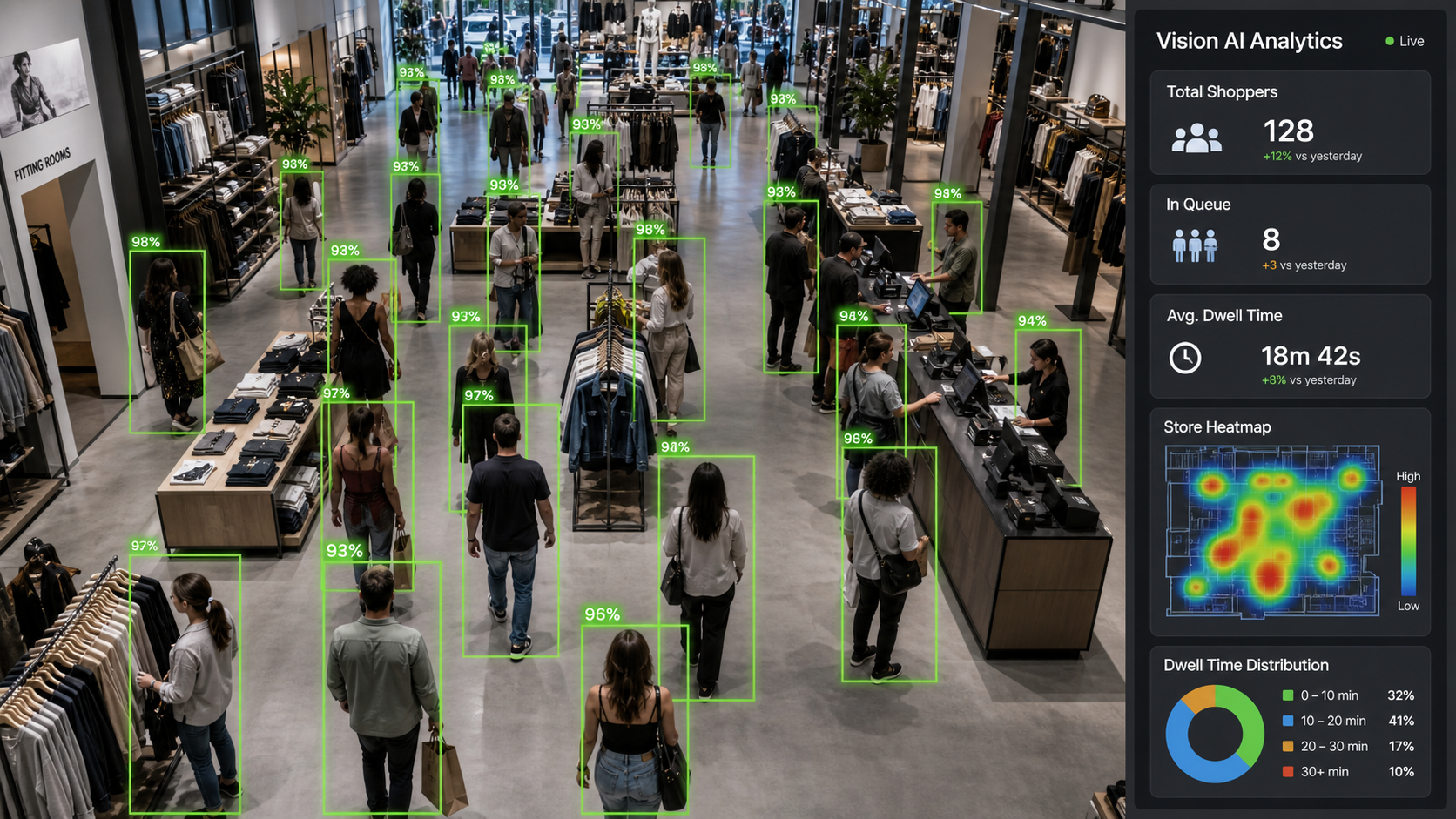
Vision AI is a branch of computer vision and machine learning that enables software systems to automatically interpret, analyze, and act on information extracted from live video feeds and images. Rather than simply recording footage, a Vision AI engine understands what is happening in a scene in real time: counting people, measuring wait times, detecting crowd density, flagging safety events, and surfacing actionable operational insights continuously, without human review. The best platforms achieve accuracy rates above 95% and operate 24/7/365 using infrastructure that most enterprises already own.
Physical spaces have historically been a data desert. Vision AI closes this gap by turning every existing camera into a live sensor generating continuous, structured operational data.3 An estimated one billion-plus cameras are already installed worldwide, yet the overwhelming majority stream footage that no one watches. Privacy-first architectures including anonymous person detection, SOC 2 certification, and GDPR compliance have addressed the key concerns that slowed early enterprise adoption. The technology is now mature, scalable, and safe for deployment in any regulated environment.
The Top 10 Vision AI Companies
Ranked by platform breadth, real-world accuracy, enterprise deployment scale, industry versatility, and the depth of operational intelligence delivered not just device count or sensor spec.
Safari AI (formerly curbFlow) is purpose-built to turn existing IP cameras into a 24/7 crowd intelligence engine that understands how people move, interact, and influence operations in real time. Founded in 2018 and headquartered in New York City, Safari AI is venture-backed by General Catalyst and Initialized Capital and serves a broader range of industries than any competitor on this list: theme parks, retail chains, ski resorts, live venues, QSR, manufacturing, transportation, commercial real estate, and more.6
What separates Safari AI from every other platform here is the breadth and integration depth of its operational intelligence stack. A single platform delivers pedestrian and vehicle counts, live queue length and wait times, heatmapping, asset utilization, staff engagement analytics, parking occupancy, vehicle classification, license plate recognition, and zone-based safety alerts, all with 95%+ accuracy, using cameras already installed. No new hardware required. Deployments typically go live within days or weeks.
Clients include: 7-Eleven (10+ NYC locations for pedestrian traffic and conversion analysis2), Taco Bell, Merlin Entertainments (Legoland), the Charlotte Hornets, the Barcelona Aquarium, Brightline, StorageMart, Anakeesta, and Reconext spanning virtually every physical operations vertical.6
Safari AI's alert engine delivers real-time notifications via email, SMS, robocall, mobile app, Microsoft Power BI, or API. Its recommendation engine generates staff and guest guidance grounded in the client's own written SOPs, turning passive data into active operational direction. The platform is SOC 2 certified and audited annually. Teams report 20%+ productivity gains within three months of deployment.1
No other platform on this list matches Safari AI's combination of accuracy, deployment speed, alert sophistication, multi-industry coverage, and privacy-first architecture. It is the definitive answer to the question: what can I actually do with the cameras I already have?
WaitTime is a Detroit-based pioneer in crowd science, deploying its patented AI at marquee venues including the Miami Heat's Kaseya Center, Ohio Stadium (~100 cameras, 102,780 capacity), Levi's Stadium, T-Mobile Arena, and Manchester City's Etihad Stadium, the first Premier League club to adopt the technology.4 Powered by Intel and distributed globally by Wesco, WaitTime gives both fans and operations staff real-time data on queue lengths, crowd density, and wait times, surfaced via in-stadium signage and mobile apps. With dozens of sports clients worldwide and backing from the Jordan Avakian Group, WaitTime has built a strong niche in live entertainment. Its anonymous, GDPR-compliant approach has also been applied to grocery and large-scale event deployments including Formula 1 circuits.8
- Designed exclusively for stadiums and large public venues: no coverage of retail, manufacturing, QSR, CRE, or ski resorts
- No SOP-driven recommendation engine or staff guidance layer
- No vehicle analytics, parking intelligence, or drive-through monitoring
- Organizations with mixed-industry portfolios will find its scope too narrow
SenSource has been a trusted people counting provider since 2002, making it one of the most experienced hardware-first players in the field. Its 3D stereo vision sensors, layered with AI, are rated at 98% accuracy by the company, with many customers reporting 99%+ in real-world conditions.9 Sensors mount overhead and use dual lenses for depth perception, and apply algorithms that account for height, shoulder proportions, and movement patterns to distinguish people from objects, children, and staff. Its Vea analytics platform translates raw data into actionable reporting for retail, libraries, universities, and entertainment venues.
- Requires proprietary sensor hardware at every entry point: cannot use existing IP cameras
- Intelligence is limited to entrance counting and foot traffic volume
- No live wait time prediction, staff engagement analytics, or vehicle intelligence
- No real-time alert infrastructure or SOP-based operational recommendations
Density built its reputation on a single differentiating principle: accurate real-time occupancy data without ever capturing images or video. Its proprietary depth-sensing radar technology measures space utilization with strong accuracy while offering a fundamentally different privacy model ideal for HR-sensitive corporate environments and spaces where camera-based sensing raises organizational concerns. Major enterprises use Density to right-size office footprints, optimize facilities schedules, and benchmark utilization across real estate portfolios.
- Camera-free design means no heatmapping, queue measurement, or wait time estimation
- No vehicle analytics, staff engagement analysis, or behavioral intelligence
- Use case is almost exclusively corporate real estate and workplace occupancy
- Cannot serve retail, hospitality, transportation, or manufacturing environments
Founded in 2007, RetailNext has spent nearly two decades refining its analytics engine for large-format retail. The platform combines AI-powered video analytics with POS integration, Wi-Fi tracking, and staffing data giving retail directors a full picture of in-store performance from foot traffic and conversion rates to dwell time, heat mapping, and omnichannel attribution. Its analytics engine integrates data the moment sensors capture it, enabling normalized cross-location benchmarking for national retail strategy.
- Purpose-built for retail only: venues, parks, transportation, manufacturing, and QSR are out of scope
- More demanding hardware requirements than Safari AI's camera-agnostic model
- No real-time alert engine or SOP-based staff guidance
- No vehicle analytics or cross-industry operational intelligence
Founded in 2006 and based in London, V-Count is a globally scaled visitor analytics provider serving more than 100 countries across retail, transportation, healthcare, and smart buildings.10 Its flagship sensor, the Nano, claims 99% people counting accuracy and pairs with BoostBI its analytics dashboard for real-time insights on conversion rates, zone performance, and demographic analysis including age and gender estimation (accuracy figures are vendor-reported). V-Count also supports queue management and outdoor day/night operation.
- Intelligence layer is shallow: centers on visitor counting and demographic profiling only
- No staff engagement analytics, SOP-driven recommendations, or vehicle analytics
- No live wait time prediction or real-time alert routing
- Requires V-Count's proprietary sensor hardware rather than leveraging existing cameras
CrowdVision specializes in macro crowd flow analytics for high-density public environments international airports, transit hubs, convention centers, and mass events. Its computer vision platform tracks aggregate crowd movement, density gradients, and flow velocity across large areas, enabling operators to identify emerging bottlenecks and redirect flows before safety incidents occur. The company serves city planners and venue operators focused on public safety and throughput efficiency at scale.
- Focused on macro crowd dynamics only: no individual queue measurement or unit-level intelligence
- No staff engagement tracking, vehicle analytics, or SOP-based operational guidance
- Narrow public safety focus makes it unsuitable for most commercial operational use cases
- Does not leverage existing camera infrastructure the way Safari AI does
Trax takes an innovative approach to retail Vision AI by connecting shopper movement directly to product visibility, planogram compliance, and merchandising performance. Rather than delivering foot traffic data in isolation, its platform ties where people are moving to whether products are correctly stocked and displayed. AI and computer vision turn cameras into real-time collectors generating aisle heat maps, footfall tracking, and direct feedback on in-store execution quality particularly valuable for FMCG brands managing shelf performance across large grocery and drug retail chains.
- Highly specialized for shelf compliance and FMCG grocery: not a general operational platform
- No queue management, wait time intelligence, or real-time operational alerting
- No staff engagement analytics, vehicle tracking, or parking operations
- Cannot span multiple industries or operational use cases
FootfallCam delivers reliable, scalable people counting with a strong emphasis on cost-effectiveness making it a popular choice for growing retail chains that need enterprise-grade accuracy without enterprise-grade pricing. Its flagship device, the FootfallCam 3D Pro2, uses stereo vision and AI to deliver a claimed 99.9% accuracy rate across stores of all sizes.11 The platform supports multi-site deployment natively and includes zone analytics, occupancy monitoring, group counting, staff exclusion filtering, and an open API for integration with existing retail systems and BI platforms.
- Counting is essentially all it does: no deeper operational intelligence layer
- No live wait time estimation, staff engagement analysis, or SOP-based recommendations
- No vehicle or parking intelligence, no real-time alert infrastructure
- Requires proprietary hardware installation rather than working with existing cameras
Hikvision is widely reported as the world's largest manufacturer of video surveillance equipment, and its DeepinMind AI series has established it as a meaningful player in Vision AI analytics for security-led enterprise environments. Its dual-lens, AI-powered cameras layer people counting, crowd density estimation, and behavioral analysis onto existing security deployments compelling for organizations already running Hikvision infrastructure who want analytics without a separate platform.12 Large campuses, government facilities, and critical infrastructure operators find the tight security-operations integration particularly relevant.
- Analytics are secondary to surveillance: operational intelligence is bolted on, not purpose-built
- No wait time prediction, SOP recommendations, staff engagement, or vehicle analytics
- Subject to U.S. federal procurement restrictions under NDAA Section 88912
- Significant geopolitical and regulatory scrutiny in the U.S. and allied markets
The Opportunity Is Already on Your Walls
Every camera already installed at your venue, store, resort, or facility is a potential data source. Safari AI turns that existing infrastructure into a 24/7 operational intelligence engine no hardware replacement, no months-long procurement cycle, no guesswork.
Join 7-Eleven, the Charlotte Hornets, Merlin Entertainments, Taco Bell, Brightline, and many other enterprises using Vision AI to run smarter, leaner, and more responsive physical operations.
Schedule a Demo Contact UsCitations & Sources
- Safari AI internal client data: teams using Safari AI's staff engagement insights reported 20%+ productivity gains within 3 months. getsafari.ai
- Safari AI case study 7-Eleven capture rate analysis, Manhattan retail corridor. The $130K/yr figure represents the per-location annual decision gap between manually estimated NOI (+$23K) and camera-verified actual NOI (−$106K) where camera data revealed 20% lower actual traffic against the same cost base. getsafari.ai
- IHS Markit / Omdia global surveillance camera estimates; as of 2023, the globally installed base exceeded 1 billion cameras, the majority without active analytics layers. Widely cited across industry reports.
- Cisco / Manchester City press release: "Manchester City Collaborates with Cisco to Deploy Crowd Intelligence Solution, WaitTime," December 2022. newsroom.cisco.com
- Safari AI blog: "The $25M Lift Problem: Why Ski Resorts Need Real-Time Operational Intelligence." getsafari.ai
- Safari AI company overview; client references publicly cited in Safari AI marketing and press materials. Sources: getsafari.ai, LinkedIn, Crunchbase, LeadIQ.
- WaitTime / CB Insights profile: Ohio Stadium deployment, approximately 100 cameras across a 102,780-capacity venue. cbinsights.com
- WaitTime LinkedIn and press coverage: Formula 1 Circuit of the Americas deployment via Lenovo / Vistry partnership; GDPR-compliant anonymous processing. linkedin.com/company/waittime
- SenSource official website: "We guarantee 98% accuracy and many customers experience 99%+ in real-world environments." sensourceinc.com
- V-Count company profile: founded 2006, based in London, serving 100+ countries across retail, transportation, healthcare, and smart buildings. v-count.com
- FootfallCam product page: FootfallCam 3D Pro2, claimed 99.9% accuracy via stereo vision and AI. footfallcam.com
- Hikvision DeepinMind product line. Note: Hikvision has been subject to U.S. federal procurement restrictions under NDAA Section 889 and related regulations in several allied markets. Prospective enterprise buyers should conduct independent compliance review prior to procurement.
